
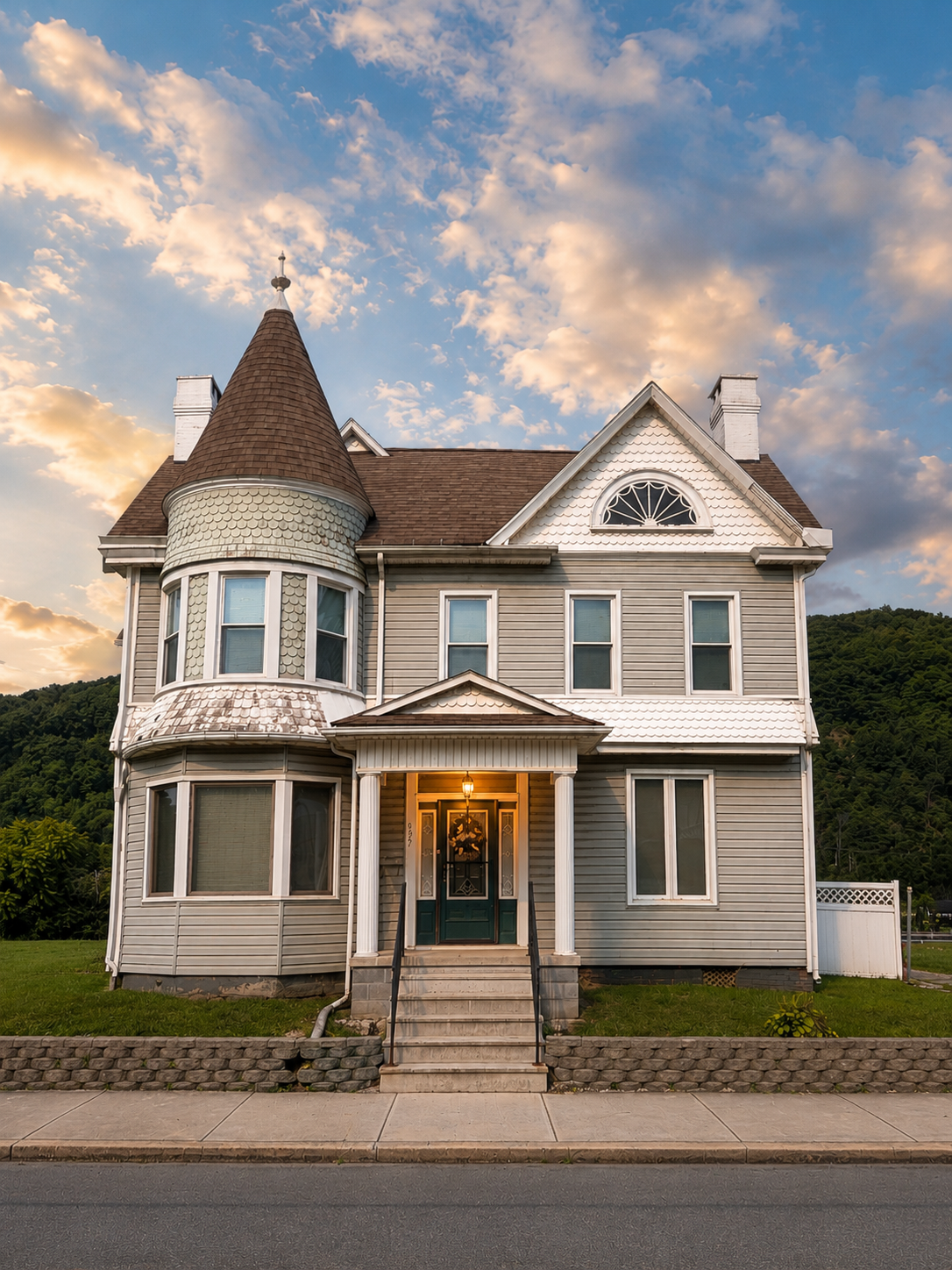
629 Somerset Street, Johnstown, Pennsylvania 15901
Best estimate: circa 1890
I could not find a dependable public record giving one exact construction year. Current property sites identify it as parcel 076001359, but their construction-year fields are blank. Based on the architecture, the house was most likely built during the late 1880s or 1890s, with about 1890 being the most reasonable working date.
Its classic Queen Anne Victorian features include:
- The round corner turret and conical roof
- Fish-scale shingles
- Asymmetrical façade
- Projecting bay windows
- Decorative sunburst window in the front gable
- Contrasting textures and ornamental trim
The modern siding, replacement windows and present front porch appear to be later alterations.
Who built it?
I found no verified architect, contractor or original builder connected to the house. However, there is a compelling connection to Johnstown’s Young family, who were successful local butchers and meat merchants.
The 1889 Johnstown directory lists:
Simon Young, of S. Young & Son, as owning a house at 129 Somerset Street. His son Simon M. Young was also living there.
The directory was canvassed between April 5 and May 6, 1889—immediately before the great flood of May 31.
Then, in 1916, an Indiana Normal School catalogue lists:
Ruth Young — 629 Somerset Street, Johnstown
A 1906 history of Cambria County identifies Ruth as the daughter of Calvin A. Young, who was Simon Young’s son.
This suggests that 129 Somerset may have been renumbered as 629 Somerset following Johnstown’s growth and municipal reorganization. The family relationship and street name make this a strong possibility, but I have not yet found a street-renumbering document or deed proving that they were the same property.
Therefore, Simon Young is best described as a possible early owner, not yet the confirmed builder.
The Young family’s Johnstown history
Simon Young was born in 1831, came to Johnstown around 1850 and worked as a butcher. He established his own meat business in 1859. His son Calvin joined the business, and it became Simon Young & Son and later Young & Young.
Calvin later organized the C. A. Young Company, a Johnstown meat-packing operation that employed approximately 35 people and reportedly conducted about $500,000 in annual business by the early 1900s—a substantial operation for that period.
If the address connection is confirmed, this house was associated with one of Johnstown’s established late-19th-century business families.
Could it predate the 1889 Flood?
Possibly. There are three scenarios:
- The existing house is the same residence recorded as 129 Somerset in spring 1889 and survived the flood.
- An earlier house stood on the property and the present Queen Anne residence was constructed shortly after the flood.
- A simpler pre-1889 house was extensively enlarged and remodeled into its present Victorian form during the 1890s.
The third possibility is fairly plausible because elaborate turrets and decorative gables were sometimes added to older houses as owners became more prosperous.
Most accurate description at present
The Young House, circa 1890 — a Queen Anne Victorian residence possibly associated with Johnstown meat merchant Simon Young and his son Calvin A. Young. The exact builder and construction year remain unconfirmed.
The decisive evidence would come from matching the property on Johnstown’s 1895 and 1913 Sanborn fire-insurance maps and tracing parcel 076001359 through the Cambria County deed indexes. Those maps record building footprints, construction materials and additions and could show whether the present turreted house existed by 1895