511 Power Street: The Historic Heart of St. Casimir’s Parish in Cambria City
Tucked beside one of Johnstown’s most impressive churches stands a building that many people pass without realizing its significance. 511 Power Street is the original rectory of St. Casimir’s Roman Catholic Church, a beautifully preserved brick residence that has quietly witnessed more than a century of faith, immigration, and neighborhood history.
While the towering church next door often commands attention, the rectory tells an equally fascinating story. It was here that generations of priests lived, parish decisions were made, families sought guidance, and the daily life of one of Pennsylvania’s most vibrant Polish-American communities unfolded.
A Home Built for a Growing Polish Parish
The St. Casimir parish was founded in 1902 to serve the rapidly growing Polish immigrant population of Cambria City. During the height of the steel industry, thousands of immigrants arrived in Johnstown seeking work at the nearby Cambria Iron Company. They brought with them not only their skills and determination but also their language, customs, and deep Catholic faith.
That same year, the parish constructed the rectory at 511 Power Street, providing a permanent residence for the clergy who would guide the new congregation. The building was completed before the magnificent stone church next door, which was finished in 1907.
More Than a Residence
A rectory is often thought of simply as a priest’s home, but historically it served many roles.
Within these walls:
- Parish records were maintained.
- Weddings and baptisms were planned.
- Families sought counseling during difficult times.
- Community organizations met with clergy.
- Visiting priests and bishops were welcomed.
For decades, the rectory functioned as the administrative and spiritual headquarters of one of Johnstown’s most active ethnic parishes.
Architectural Character
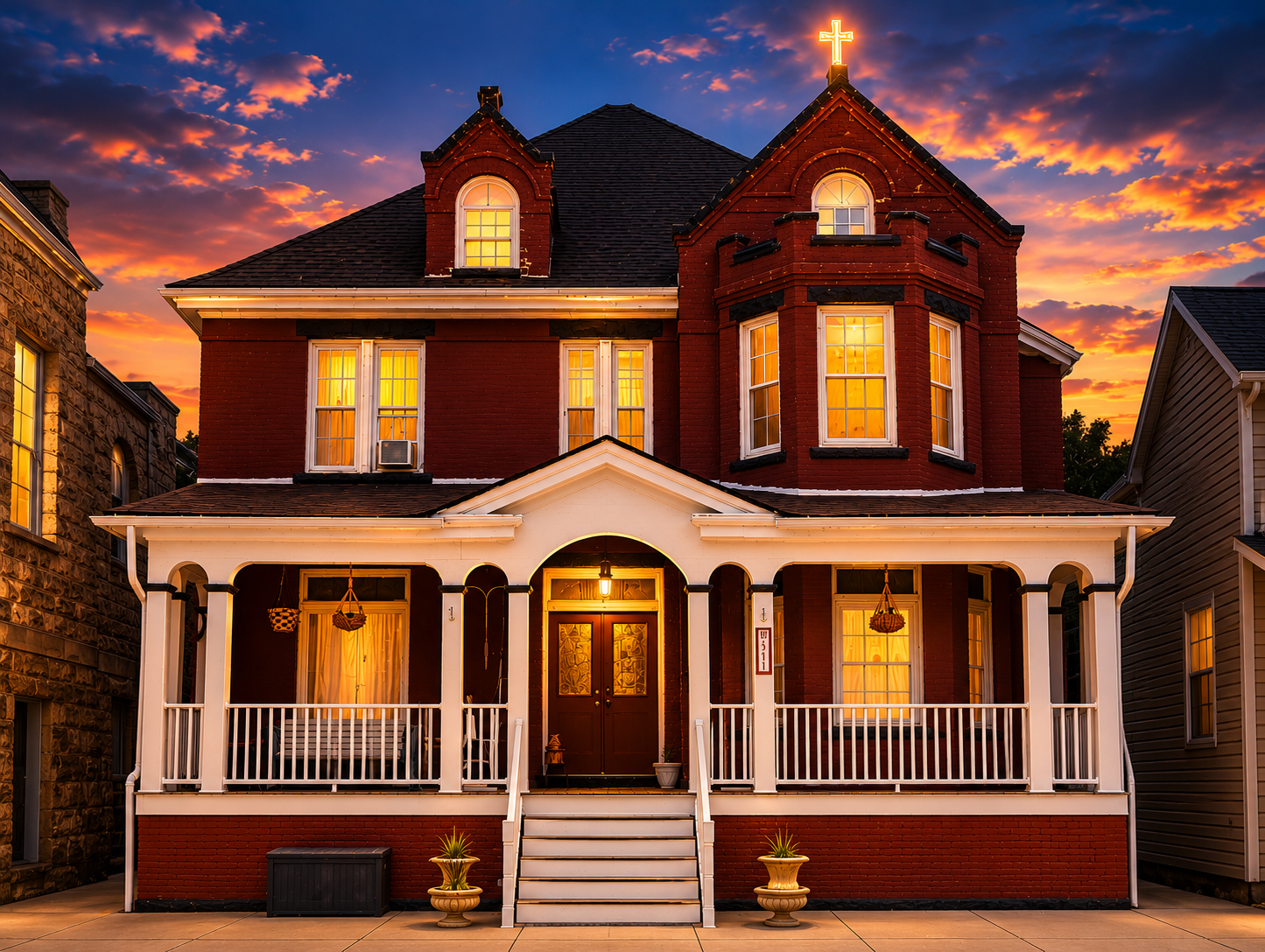
The rectory is an outstanding example of early twentieth-century ecclesiastical residential architecture.
Among its notable features are:
- Rich red-brick masonry
- A broad wraparound porch with graceful arches
- Steep rooflines with decorative dormers
- A prominent rooftop cross
- Tall Victorian windows that flood the interior with natural light
- Fine brick detailing around windows and cornices
Although designed as a residence, the building projects a sense of permanence and dignity that complements the monumental Gothic Revival church beside it.
Standing Beside a Landmark Church
Immediately adjacent to the rectory is St. Casimir’s Roman Catholic Church, completed in 1907 and designed by architect Walter R. Myton. The church was built in the Gothic Revival style using rough-faced stone and steel donated or financed through the Cambria Iron Company and the sacrifices of Polish steelworkers.
Together, the church and rectory form one of the finest surviving parish complexes in western Pennsylvania.
Recognized by the Library of Congress
One of the strongest indications of the rectory’s importance is that it has been documented by the Historic American Buildings Survey (HABS), a federal preservation program administered through the Library of Congress.
The official HABS record identifies the building as:
St. Casimir’s Roman Catholic Church, Rectory I
511 Power Street
Built in 1902
Only buildings considered historically or architecturally significant are selected for HABS documentation, placing this rectory among Johnstown’s recognized historic resources.
A Neighborhood Built by Immigrants
Power Street lies in the heart of Cambria City, one of Pennsylvania’s most important historic immigrant neighborhoods.
During the early twentieth century, the surrounding streets echoed with Polish, Slovak, Hungarian, Croatian, German, and Italian languages. Churches, bakeries, social clubs, taverns, and small businesses created a vibrant community centered around family and faith.
The rectory stood at the center of that daily life, witnessing generations of baptisms, weddings, funerals, feast days, and community celebrations.
A Photographer’s Dream
Today, 511 Power Street remains one of the most photogenic historic buildings in Johnstown.
Its warm brick façade catches the evening sun beautifully, while the rooftop cross, ornate porch, and historic architectural details make it an exceptional subject for architectural photography.
As daylight fades, the building takes on an especially inviting character, with warm tones highlighting the craftsmanship that has endured for well over a century.
Preserving a Legacy
The former church campus has entered a new chapter through the Casimir Cultural Center, which preserves the legacy of St. Casimir Parish and celebrates the history of Cambria City’s Polish-American community. The center continues to honor the stories, artifacts, and traditions that originated in this remarkable neighborhood.
A Quiet Treasure of Johnstown
Not every historic landmark announces itself with towering spires or grand monuments. Sometimes the most meaningful buildings are the ones that quietly served their communities every day.
At 511 Power Street, generations of clergy opened their doors to parishioners seeking comfort, guidance, and hope. The building has survived changing neighborhoods, industrial booms and busts, floods, and more than 120 years of history.
Today, it remains one of Cambria City’s finest architectural treasures—a graceful Victorian rectory whose story is inseparable from the history of Johnstown itself.